I've written a review of QEMU Virgil, a virtualization solution based on KVM and Virgil 3D, offering improved 3D graphics capabilities in virtual machines, covering setup, virtual machine and hard disk creation, test case, performance benchmarking, and more. Have fun.
from Dedoimedo RSS https://ift.tt/30pvdT9
via IFTTT

The Latest News from Across the FOSS Universe
Friday, October 2, 2020

Fix Spotify Video Podcasts Not Working on Ubuntu Linux
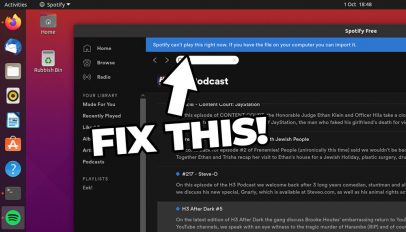 Learn how to get Spotify video podcasts working on Linux. The fix is quick and easy and once done lets you watch video podcasts on Spotify in the Linux app.
This post, Fix Spotify Video Podcasts Not Working on Ubuntu Linux is from OMG! Ubuntu!. Do not reproduce elsewhere without permission.


from OMG! Ubuntu! https://ift.tt/3n8PRkm
via IFTTT
Development Release: Ubuntu 20.10 Beta
Canonical has published a new development snapshot of Ubuntu. This snapshot, Ubuntu 20.10 Beta, is accomplanied by beta of the distribution's official community editions. "20.10, codenamed "Groovy Gorilla", continues Ubuntu's proud tradition of integrating the latest and greatest open source technologies into a high-quality, easy-to-use Linux distribution. ....
from DistroWatch.com: News https://ift.tt/3cOj7YY
via IFTTT
from DistroWatch.com: News https://ift.tt/3cOj7YY
via IFTTT
Why Does Eric Raymond Think Windows Will Lose Desktop War To Linux?
Last week, Eric Steven Raymond (often known as ESR) penned an article arguing that this could be the last phase of desktop wars and Linux will eventually win it gracefully. But how?
As he observed, Linux will not replace Windows, instead, Windows will become an emulation layer on top of the Linux kernel.
Before we take the argument forward, let me tell you that Eric S. Raymond is an open-source advocate, and a writer, widely known for his most popular work “The Cathedral and the Bazaar.” Besides his several write-ups, he has also co-founded and served as president until 2005 of the Open Source Initiative.
Obviously, one of the reasons he mentioned is the gradual development of the Windows Subsystem for Linux (WSL), which has kept adding features to ease running Linux binary executables natively on Windows 10.
Microsoft started this with WSL, then refreshed it wholly to launch WSL 2 which brought full Linux kernel to Windows 10, Linux File Integration, DirectX on Linux, Linux file system, and a lot more to come like Linux GUI app.
Besides WSL, Microsoft recently also confirmed it will launch the first Microsoft Edge for Linux previews in October. And how can we forget Microsoft’s big bet, Azure, a cloud computing platform, and the official Linux-based Azure Sphere OS?
According to Eric, Microsoft’s revenue stream has changed since the launch of its cloud service in 2010 as Azure now makes most of its money. On the parallel, the sales of conventional desktop PCs are also declining, which results in the fall of investment in Windows development.
That is why Microsoft will eventually prefer putting more capital investment into Azure than continuing Windows development. The irony is that Linux is already the most in-demand OS on Azure.
Last but not least, Eric believes that Proton also has an important role to play for Linux winning the desktop wars. Proton is a Wine-based emulation layer that allows Microsoft Windows games to run on Linux-based operating systems.
With Proton, not perfect yet, getting close enough to run Windows business software over Linux, Microsoft will start reducing its development costs to maintain Windows 10.
In the end, Raymond sees the new Windows as an emulation layer on top of the Linux kernel, support for Windows-compatible tools moving to Linux, and Microsoft focusing so much on Azure that it will stop spending money on Windows.
Eventually, the end of Windows emulation layer too.
Via — TheRegister
The post Why Does Eric Raymond Think Windows Will Lose Desktop War To Linux? appeared first on Fossbytes.
from Fossbytes https://ift.tt/34grCIk
via IFTTT
Fedora 33: What’s Coming In The Next Stable Release?
Fedora is a Red Hat-sponsored community project that develops a bleeding-edge Linux-based operating system. Fedora 32 is the current stable version released on April 28, 2020.
Continuing the development cycle, the community is already working towards the release of the next stable Fedora 33. Hence, in this article, I’ll list down all the new changes that are confirmed to be available in Fedora 33.
Speaking of the release date, there is no exact date finalized. However, the beta version has been released and as per the official schedule, October 20 is the preferred final target date and October 27 is the final target date for the stable version release.
Fedora Linux 33: What’s New?
Switch From Ext4 To Btrfs Filesystem
Last month we reported that a new proposal was sent to bring major changes to the Fedora desktop variants. Subsequently, it has now been confirmed that Fedora will transition from ext4 to Btrfs filesystem by default.
However, the new default file system will only apply to Fedora Workstations and Spins across x86_64 and ARM architectures. Fedora chose Btrfs to bring benefits by resolving several problems such as running out of space, storage data corruption, filesystem resize, and complex storage setup.
Nano As Default Terminal Text Editor
Another major system-wide change to Fedora 33 is the default terminal text editor. As you may know, currently Vi is the default terminal text editor in most cases, such as git commit and command-line text editing.
But now with Fedora 33, GNU Nano will replace Vi to become the default text editor across all of Fedora’s editions. However, you’ll also have Vi pre-installed through a vim-minimal package.
GNOME 3.38 Desktop Environment
Upgrading the previous GNOME 3.36, Fedora 33 will come with a recently released GNOME 3.38.
With GNOME 3.38 desktop, you’ll have a new Welcome Tour app written in Rust, better multi-monitor support, QR Wi-Fi Hotspots, custom application grid, and various GNOME apps improvements.
Fedora IoT As Official Edition
In addition to Fedora Workstation, Server and other editions, Fedora IoT is a new official edition for those who want a lightweight yet powerful and scalable core OS for the Internet of Things project.
Interestingly, Fedora IoT supports a variety of hardware platforms based on x86_64 and aarch64, which includes Raspberry Pi and PINE64. For more details about Fedora IoT, check here.
Enable EarlyOOM By Default
EarlyOOM was the highlighting feature of the previous Fedora 32 Workstation, which installed earlyoom package and enabled it by default to resolve the slowing down of UI during heavy swap usage or low-memory situations.
With Fedora 33, EarlyOOM is also now enabled by default for Fedora spins with KDE Plasma Desktop.
Core Package Update
Besides the new enhancements, Fedora 33 has also upgraded its core tools and packages to include the latest version such as:
- GNU C Library version 2.32
- Golang 1.15
- RPM 4.16
- LLVM 11
- GNU Make version 4.3
- Node.js 14.x
- Perl 5.32
- Python 3.9
- Ruby on Rails 6.0
- Erlang 23
- LXQt 0.15.0
- DXVK as default wined3d backend
Other Updates To Fedora 33
- Better thermal management and peak performance on Intel CPUs
- Default animated background for Fedora Workstation
- Removal of Python 2.6 and Python 3.4
- .NET Core is now available on aarch64 Fedora
For complete details, you can also check out the Fedora 33 Change set.
The post Fedora 33: What’s Coming In The Next Stable Release? appeared first on Fossbytes.
from Fossbytes https://ift.tt/2Q657iK
via IFTTT
Thursday, October 1, 2020
Ubuntu 20.10 Beta is Now Available to Download
 The Ubuntu 20.10 beta build is now available to download. This release gives users the chance to go hands on with planned changes, including GNOME 3.38.
This post, Ubuntu 20.10 Beta is Now Available to Download is from OMG! Ubuntu!. Do not reproduce elsewhere without permission.


from OMG! Ubuntu! https://ift.tt/2EP2pvQ
via IFTTT
Linux Mint is Working on a New Sticky Notes App
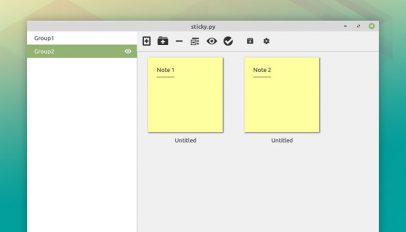 Linux Mint is working on a new sticky notes app. It lets users put Post It style notes on their desktop to show reminders, to-dos, and other tasks or notes.
This post, Linux Mint is Working on a New Sticky Notes App is from OMG! Ubuntu!. Do not reproduce elsewhere without permission.


from OMG! Ubuntu! https://ift.tt/33n8wRL
via IFTTT
Subscribe to:
Posts (Atom)
-
Introduction I am aware that it is a while since I added any content to this site. To be honest I have been inundated with work and so I ha...
-
Instagram is the money-making machine of Facebook. According to a report by Bloomberg, Instagram brought in $20 billion in 2019 through ad...
-
Ubuntu 17.10: Unity is gone and gnome shell is in as the default desktop. But how does it function? What about the Linux software and how d...


